
Global Coalition for Inclusive AI
Missions Publiques and Stanford Deliberative Democracy Lab coordinate citizen deliberations on AI governance and work to connect their results to institutional responses.
Organisations coordinating the coalition
Missions Publiques
Citizen deliberation and public participation.
Visit organisation ↗Stanford Deliberative Democracy Lab
Research and practice in Deliberative Polling.
Visit lab ↗The February 2025 launch announcement also recorded support from the governments of France, Switzerland and the United Kingdom, and named ENS-PSL and Yale University as collaborators on an early student assembly. Read the announcement ↗
Why the coalition exists
Artificial intelligence is changing public services, work, education, health and democratic life. The people living with those changes rarely have a meaningful place in decisions about priorities, risks or safeguards.
The Global Coalition for Inclusive AI is building a durable way for citizens to deliberate on those choices and for institutions to hear, consider and respond to their informed judgments. It pays particular attention to communities usually absent from international technology debates.
How the coalition is organised
Deliberation becomes more useful when partners can organise it well, compare what they learn and connect the results to real decisions.
- 01 · Coalition hubGovernance, resources and learning
- Secretariat · Advisory Board · AI Dialogues Academy · regional and sectoral hubs
- 02 · Deliberation ecosystemLocally grounded citizen dialogue
- Different formats, shared quality standards, accessible information and comparable evidence
- 03 · Impact and dockingInsights that institutions can use
- Global synthesis, tailored briefs, partner commitments and documented responses
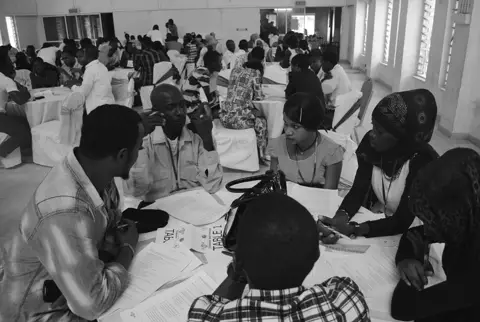
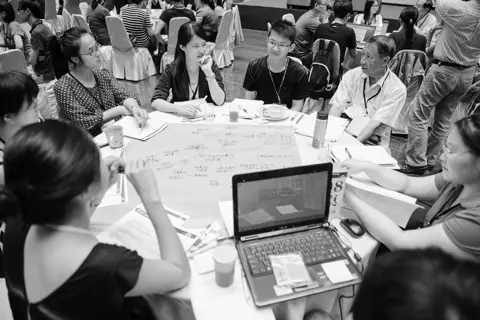
Archival photographs from earlier citizen dialogues in the Gambia and Taiwan illustrate the participation layer.
How participation can inform AI governance
The goal is to make citizen deliberation a normal part of AI governance, rather than a one-off consultation.
- 01 · InputsBuild the infrastructure
A balanced coalition, trained local partners, accessible materials and shared methods.
- 02 · ActivitiesDeliberate together
People learn, question, weigh trade-offs and discuss AI choices across contexts.
- 03 · OutputsMake judgments usable
Comparable findings, local recommendations, synthesis and tailored evidence.
- 04 · Intended outcomesInform decisions
Institutions consider, respond to and, where appropriate, act on citizen insights.
Documented responses and evaluation feed the next deliberation cycle.
Formats and quality standards
The coalition is designed as an ecosystem, not a single global consultation. Contributions may differ in scope, scale and method while meeting common quality requirements.
- Scope
- From broad AI governance questions to specific issues in health, education, labour, climate, culture or democracy.
- Scale
- Local, national, regional, transnational or global processes can inform one another without erasing their context.
- Method
- Citizens’ dialogues, assemblies, juries, deliberative polling, youth forums and other suitable formats can contribute.
Quality and inclusion: recognised contributions should use transparent recruitment, unbiased facilitation, informed consent, accessible and balanced materials, secure data handling and clear reporting. Common modules support comparison; local modules give participants room to address what matters where they live.
Institutional response and follow-up
The coalition calls this connection docking: preparing institutions to receive results, turning findings into useful formats and tracking what happens next.
Partners will be invited to make voluntary commitments suited to their mandates. The concept note describes a progression from acknowledge and consider, through respond and consult, to incorporate and implement. A light public record of these steps is intended to make uptake visible without claiming that every recommendation was adopted.
Outputs are meant to serve different audiences: policy options for governments, evidence on public expectations for companies, advocacy resources for civil society, comparative material for researchers and clear feedback for participants.
Proposed governance and safeguards
The proposed governance combines day-to-day coordination with diverse oversight and local ownership.
The secretariat would coordinate operations. A multistakeholder Advisory Board would guide strategic decisions, while regional and sectoral hubs would bring different contexts and interests into those decisions. The concept note also calls for former participants to gain a voice in the coalition’s learning and accountability.
Key safeguards respond to familiar risks: token consultation, exclusion from recruitment, uneven methods, capture by any one interest and results that never reach the public. The coalition proposes transparent standards, training, balanced governance, early engagement with decision-makers and visible follow-up.
Questions the coalition may address
The agenda is intended to remain globally relevant and locally adaptable.
- Fair access to AI’s benefits
- Governance and accountability
- Data, privacy and human rights
- Work, education and skills
- Trust and human oversight
- Sustainable development and climate
- Human wellbeing
Planned phases, 2024–2035
These are planned phases from the concept note. The timing and activities may change as partners and governance arrangements develop.
- 2024–early 2027Foundation and launch
Build partnerships, define governance and prepare the first contributions.
- 2027Design and pilots
Test formats, train partners, refine materials and prepare routes into policy.
- Late 2027–mid 2028Broader rollout
Connect locally grounded dialogues with comparable international evidence.
- Mid 2028–2029Docking and evaluation
Publish findings, engage institutions, document use and design the next cycle.
- 2029–2035Institutionalisation
Support repeated cycles and embed deliberation in AI governance practice.
Documented milestones
These documented moments trace the coalition’s development and related deliberative work. The Belgian panel preceded the coalition and is presented as relevant experience, not as a coalition-run process.
- 2024 · Belgium
Citizens deliberate on AI in Europe
During Belgium’s EU Council Presidency, 60 people selected by lot developed a citizen vision for AI in Europe. Missions Publiques designed and facilitated the process. It is a precursor and example of the method, rather than a coalition deliberation.
- September 2024 · New York
A global process enters discussion
Alongside the UN Summit of the Future, Missions Publiques, Stanford’s Deliberative Democracy Lab and 1014 convened a discussion on a global deliberative process for AI governance.
- February 2025 · Paris
The coalition formally launches
Missions Publiques and Stanford’s Deliberative Democracy Lab launched the coalition during the AI Action Summit, at ENS-PSL.
- By February 2025 · ENS-PSL
A student assembly tests the approach
An early Student Citizens’ Assembly involving 70 students was coordinated by partners at ENS-PSL and Yale University. The launch announcement describes it as a first experiment.
Public record
Deliberations and precedents
- ENS-PSL Student Citizens’ Assembly on AI (2025) Coalition pilot
- Belgian Citizens’ Panel on Artificial Intelligence (2024) Earlier related work
Work with the coalition
Convene a local deliberation, contribute research or facilitation, support participation, or help an institution receive and respond to citizens’ recommendations.
Contact the coalition team